


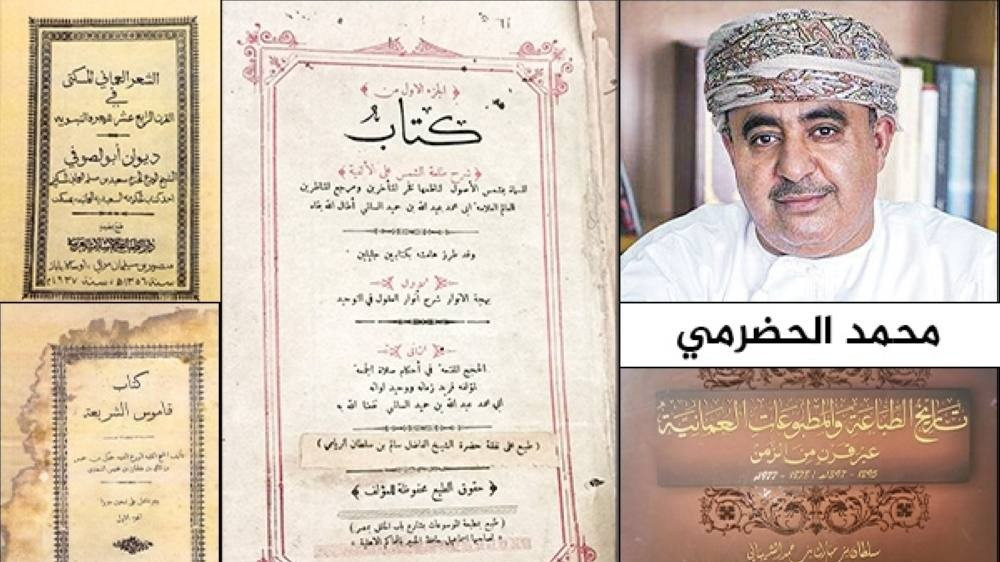
Since the late nineteenth century and the beginning of the twentieth century, printing presses in the Arab and foreign countries have published many books by Omani authors in various fields, such as: literary, history, law and medicine, poetry and prose, articles, studies and readings, and the list goes on, but most of these editions are out of stock, and there are only a few of them. Some of which were issued in Zanzibar, by the “Sultaniya Press”, which published many books, and some of which were issued by Egyptian presses such as the “Baronial Press”, and some of them were issued in the sixties, by the Arab Press in Damascus, or in the Islamic Maghreb, or Japan, and the rest of them are considered anecdotes of Omani publications.
Likewise, the books issued after the seventies, the generation of the modern Omani Renaissance, are not any better. For example: If we search for the first edition of Abdullah Al-Khalili’s Diwan “The Revelation of Genius”, issued by the Ministry of National Heritage and Culture 1978 AD, with its beautiful green cover, it is the first book published by the poet, and its texts have been dissolved in the “Poetry Encyclopedia of Amir Al-Bayan”, issued in 2018, with the investigation of Saeed bin Salem Al-Noamani. Also, there is no copy of the poet Abu Surur Al-Jami’s collections: “Packets of Literature” 1975 AD, and “To the Forum’s Forum” 1978 AD.
If any of the researchers wanted to see the first creations of Abdullah Al-Ta’i, one of the pioneers of modern literary writing, I do not think they could be found easily, especially the books that were issued outside the country, such as “The Creeping Dawn” issued in Kuwait 1966 AD. Additionally, if a critic needs a copy of one of the the story collections that were issued to the narrator Ahmed bin Bilal, such as his first collection of stories “The Wall of Minaya” 1981 AD, or “The Earth was brought out” 1983 AD, or “No, O stranger” 1987 AD, where would the critic find them? They are out of date, and there are no copies.
A ministry concerned with cultural affairs, such as the Ministry of Culture, Sports and Youth under its new name, started the manuscript printing project in the late seventies, where the last statistics of its publications amounted to 653 publications, including books issued by the Manuscripts Department in the Ministry, which amount to 328 titles. Most of the first editions of these books are out of stock, including valuable editions of books printed in Egypt, some of them from the Arab Register presses, such as the book “Fath Al-Kamam An Al-Ward Al-Bassam” by Saif bin Hamad Al-Aghbari, issued in 1981 AD, and other books printed at the Issa Al-Babi Al-Halabi Press And his partners, such as “Explanation of the pillars” by Ibn Wassaf, verified by Abdel Moneim Amer. and the first parts of “The Methodology of the Students and the Communication of the Desire” by Sheikh Khamis bin Saeed Al-Shaksi, published in 1980 AD, reviewed by Sheikh Salem bin Hamad Al-Harthi, and “Diwan Al-Maawali” in 1984 AD, reviewed by Dr. Muhammad Abdel Moneim Khafaji, and other publications.
Other than books, there are the Omani newspapers that were published in East Africa during the first half of the twentieth century, such as “Al-Najah” which was published in 1911 AD, and lasted for three years, and is considered one of the early days of the Arab press, followed by “Al-Falaq” which began to be published in 1929 AD, then the newspaper “Al-Murshid” in 1942, and “Al-Nahda” newspaper in 1951.
There are magazines and periodicals issued in the Sultanate during the seventies, their material varied between politics, thought, literature and the arts, but they stopped and became news, such as Al-Aqeedah Magazine: 1970 AD, Al-Wahi: 1975 AD, Al-Sarraj: 1975 AD, Al-Ghadeer: 1977 AD. In the Omani Encyclopedia there is a special entry for the press that includes information about it, and all of it represent a cultural tributary for the researcher, so where did their published numbers go? The loss of archives for these magazines is a loss of an important journalistic history.
We have the National Documents and Archives Authority, and they thankfully showed me a list of six titles of Omani books kept by the Authority, published in the late nineteenth century and the beginning of The twentieth century, the oldest of which is the book “Explanation of the Sunrise on the Millennium of the Sun’s Origins”, its first edition was issued in Egypt in 1899 AD, fifteen years before the death of its author, Sheikh Al-Salmi.
Some of these editions also reveal a group of supporters of culture and its production, and that they were printed on the expenses of citizens who contributed their money to the printing of books, for example, Salem bin Sultan Al-Riyami, who printed the book “Explanation of the Sunrise,” and Suleiman and Ahmed, sons of Muhammad Al-Salmi, who printed “Diwan” Al-Satalli” and “Diwan Al-Nabhani”, as Muhammad bin Nasser Al-Rubkhi and Amer bin Suleiman Al-Hamimi from Bahla printed the book “Al-Da’a’im” by Ibn Al-Nadhar. It is important to document their names and their cultural history, because without them the precious books would not have exited.
Our homeland, Oman, needs a national library that preserves its knowledge heritage and intellectual creativity, in all its forms and formats, especially the first edition of every book, before it becomes a fable of the beautiful past. Our diverse and multiple cultural product is not lost, and until our cultural archives abound, one copy is sufficient for every issue issued in the Sultanate, for a writer, researcher and thinker, and every person engaged in writing, regardless of his intellectual and cognitive tendencies, in order to make of our publications our own library, which remains a source of pride for generations. The printed cultural is as important as the manuscript legacy.
He concluded by noting an important book published by the researcher Sultan Al Shaibani, entitled: “The History of Omani Printing and Publications through a Century of Time” (1295-1397/ 1878-1977 AD), in which he investigated what was published of Omani publications during a century, in various countries. Those publications that were born strange, outside their Omani homeland: in Europe, Egypt, Arabia, India, Bengal, and others.